Thursday, April 28, 2016
Many of you will remember studying about Pompeii in school. Let me tell you, the history books could not do the Pompeii tragedy justice. It is hard to imagine what all those people went through. They had no warning of what was about to happen and although Vesuvius had been active, the people had no idea it would erupt in such a vicious manor causing such total annihilation. The events of this natural disaster were recorded in letters by Pliny the Younger as he gave a detailed account of what he witnessed and of what his Uncle, Pliny the Elder sent back to him by message. (Pliny the Elder died in the volcanic disaster, but not before rescuing some people by boat.) The letters of Pliny the Younger (found in the 16th century) are a documented event of the catastrophe that devastated Pompeii and the surrounding villages.
At the time (August 24, 79 A.D.) about 20,000 people lived in Pompeii and the surrounding areas. Some accounts list the loss of life at 2000 people that did not escape. This map shows the cities that were destroyed by Vesuvius.

Within 24 hours Vesuvius dropped 14 to 20 feet (yes feet!) of volcanic ash on Pompeii. That is over 6 inches of ash per hour, it’s hard to even imagine. The heat was so intense that the eyes of man and beast would burst and all liquid would evaporate from the bodies. For others in Pompeii that were not in the direct intense heat, they were being engulfed in ash. Being covered in ash would be like sticking your head in a bag of powder dry cement while someone punched in the sides of the bag. Either would have been a miserably horrendous death, however, thankfully very brief in duration. Below is the current main entrance into Pompeii.


Our guide with the blue baseball hat on. He spoke very good English, a little too much actually….
As the lava and ash hardened, preserving the city and molds of its former inhabitants, looters already laid in wait of the riches buried encapsulated within Pompeii. I am not really sold on the idea of looting as much as the thought of recycling at its earliest period in time. Things like carved marble paving stones and precious jewels and items near the surface were looted. Then Pompeii was forgotten until 1748 when a group of archaeological explorers discovered Pompeii was well preserved under the ash.
In 1860 when Giuseppe Fiorelli, began excavations, he was the first to pour plaster of Paris into the empty spaces left by the original organic elements which had decomposed after the volcanic ash solidified.

This man captured eternally in his last moments of life. It made me sad that his plaster cast sits in a room among all this pottery.


Look closely at the glass case. Inside, the mold of a dog, trying desperately too free himself of the chained collar, which, is holding him as a captive hostage during the eruption.
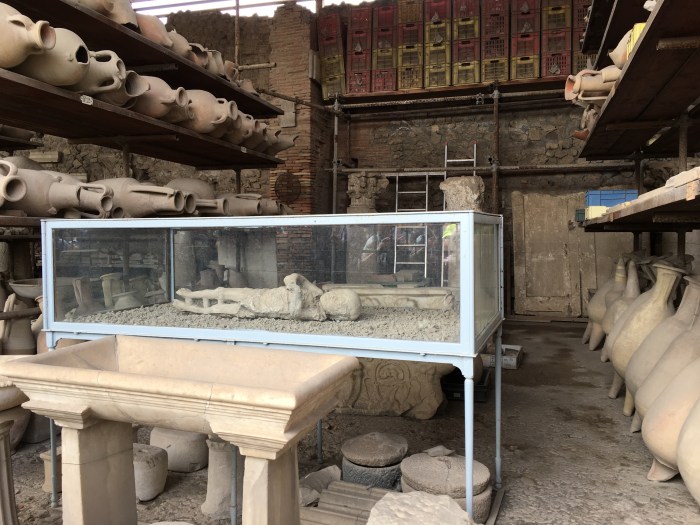
This young child laying alone. Other sections had casts of entire families laying together, mothers holding babies, but the ones of lone people were the hardest to imagine.
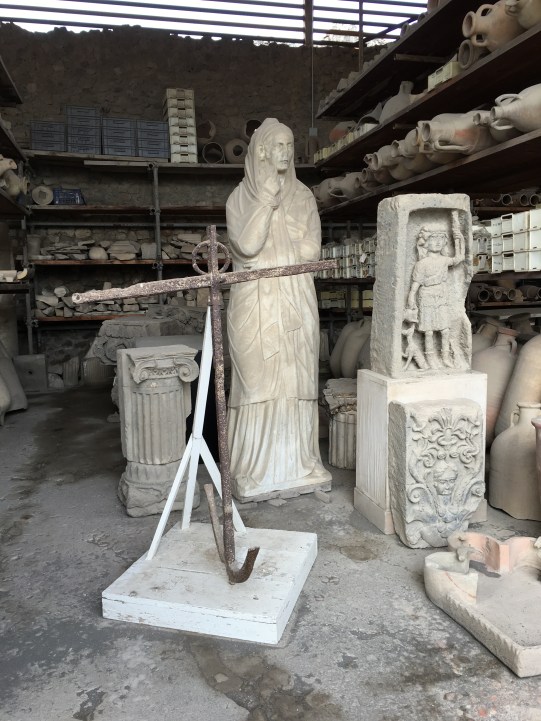
Of the 163-acre city, 1/3rd is still buried and will take approximately 100 years for the excavation to be completed. (Does anyone want to join my Mom, sisters and I for our next trip in 100 years to see the entire city?) The architecture was simply remarkable and even more so considering the tools and supplies available at the time.


The next two photos are taken inside the men’s bath house. It is mind-blowing how they designed the rooms. This room has upper windows that allow the sun and starlight in the room at all times of the day or night without letting in the rain.


The paintings on the walls and ceiling, statues, intricate carvings and inlaid tile work are true works of art, engineering and craftsmanship even by today’s standards. The bathhouse had several rooms including a changing room, cool bath, warm bath, and hot bath.


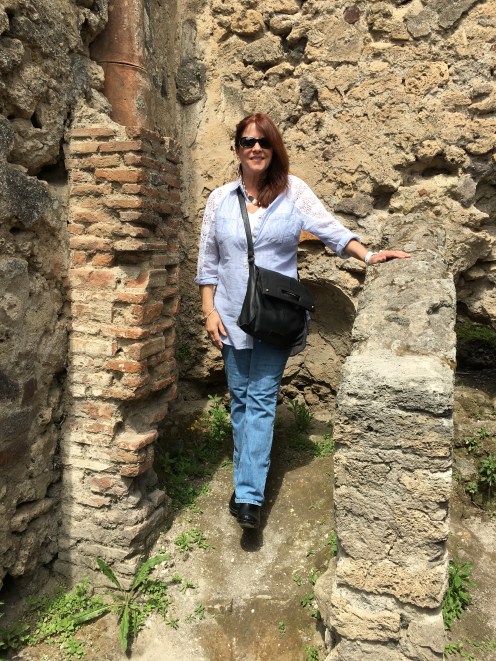
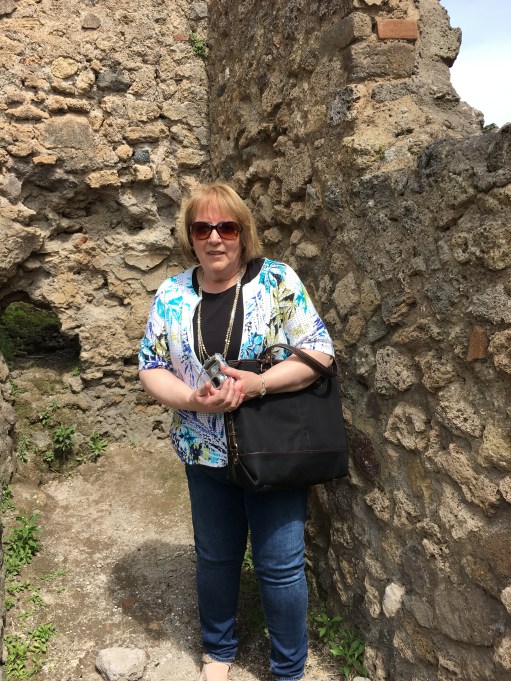


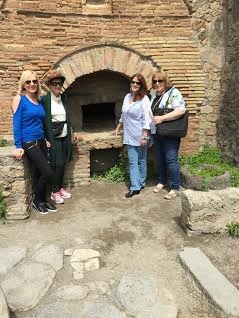
Kathy (and Linda’s forehead and nose) at one of the larger bakeries in the market section. I read that there were 81 loaves of bread cooking in the bakery of Modestus in Pompeii on the day of the eruption. The next photo of all 4 Jarvey girls at the bakery.
Below are tile-work samples in some of the more elaborate homes. (There were 35 homes with private bathrooms found in Pompeii.)


I don’t remember what the terminology was, but in today’s world it would be called a house of prostitution. It had several rooms and each had a painting over the door. This explained which “act” would be performed in that room. The beds were really short as were some of the common area doorways. The Pompanos must have been very short! Wish I could have gotten someone to lay down on one of the beds just to give a perspective.


Of all the places we toured, this is one that I would really like to read more about and also to return to someday while it is still there too return to. Although Mount Vesuvius has not erupted since 1944, it is still considered one of the most dangerous volcanoes in the world. Experts believe another catastrophic eruption is due any day. Almost 3-million people live within 20 miles of the crater of Mount Vesuvius.
I think we had walked enough so were ready to say good-bye to Pompeii and meet up with our driver. The next stop was Naples to take in the view of the harbor, eat at a local pizzeria and to tour a castle. It would be a little hard to top Pompeii, but we were up for just about anything, although let me tell you I was really glad for the car ride and rest that it provided.
We stopped for a view of the harbor, but, all I have photos of is this tiny little car that I found so amusing, I mean just look at how compact it is.


Next stop was a little pizza place in the Spanish Quarters – Quartieri Spagnoli. I do not remember positively; however, I believe it was Pizzeria Napoli. We didn’t have to translate the menu to order; the pizza lunch was included and our driver (whats his name) ordered for us.


We each received a whole pizza! And gosh darn it, didn’t we each eat almost the entire pizza!? Must have been all that walking around, anyway, that’s my story.
Below is a picture of the girls with our driver. I don’t remember his name, but, he did speak English! That is how pizza’s are in Italy. Hand tossed crust, sauce, some cheese and a few pieces of fresh basil.


I believe the pizza gave us a little energy because believe it or not we were ready to tour Castle Nuovo.
Castle Nuovo is in central Naples. The initial castle was built in 1279 and remains one of the main architectural landmarks of Naples. The picture below taken from the WiKi was taken by Richard Nevell of London.
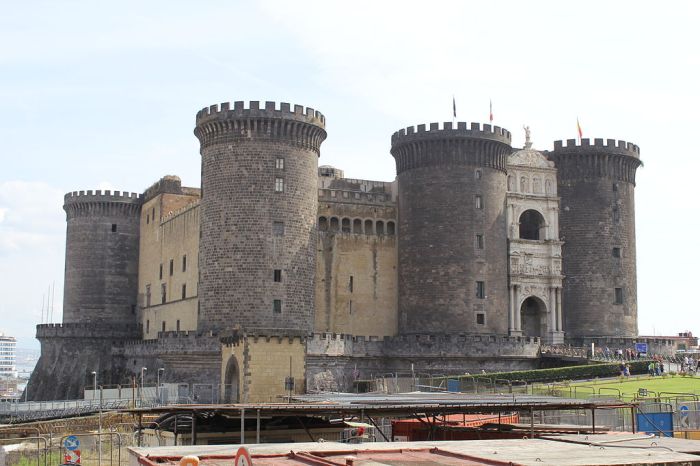
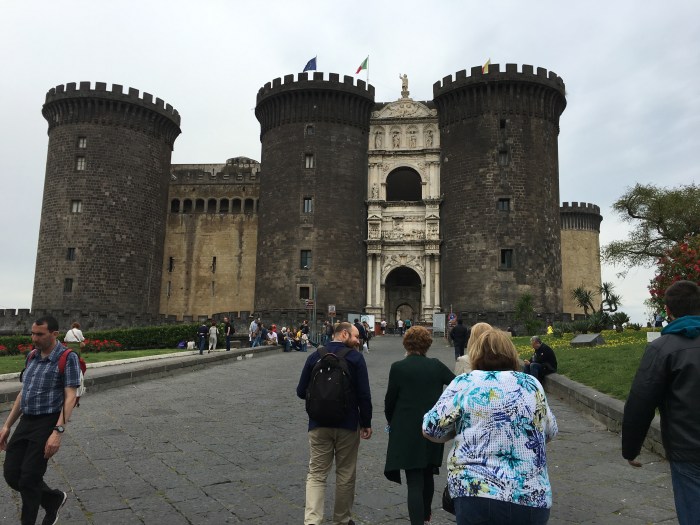
Our driver purchased our tickets, but, did not go inside the castle with us.
Barons’ Hall: Photo by Richard Nevell of London. Get a load of that extremely high ceiling.


Inside the castle, there were different sections of museums; one with glass floors so you could look into the cellars or dungeons. That part was sort of creepy.


Kathy couldn’t go into those rooms because of the glass floor and all. (She has an issue with heights, elevators, escalators and glass floors.)


You see from the pictures why it was creepy. Were they slaves? Prisoners? Was this just the normal burial process? Who knows? I didn’t research it. I can tell you one thing, after all that walking, we all slept really good!
Next Post; The Basilica.
 5117 Melbourne St., Unit 4103
I thought Pompeii was truly awesome! You captured some of the same that we saw. Vesuvius will certainly be a newsmaker when it erupts again. I hope with all the technology available today they heed any warnings detected and many people escape before the devastation occurs again. Well done.
LikeLike
Thanks Sue! Someday we have to meet in person. My sister has all good to say about you.
LikeLike